

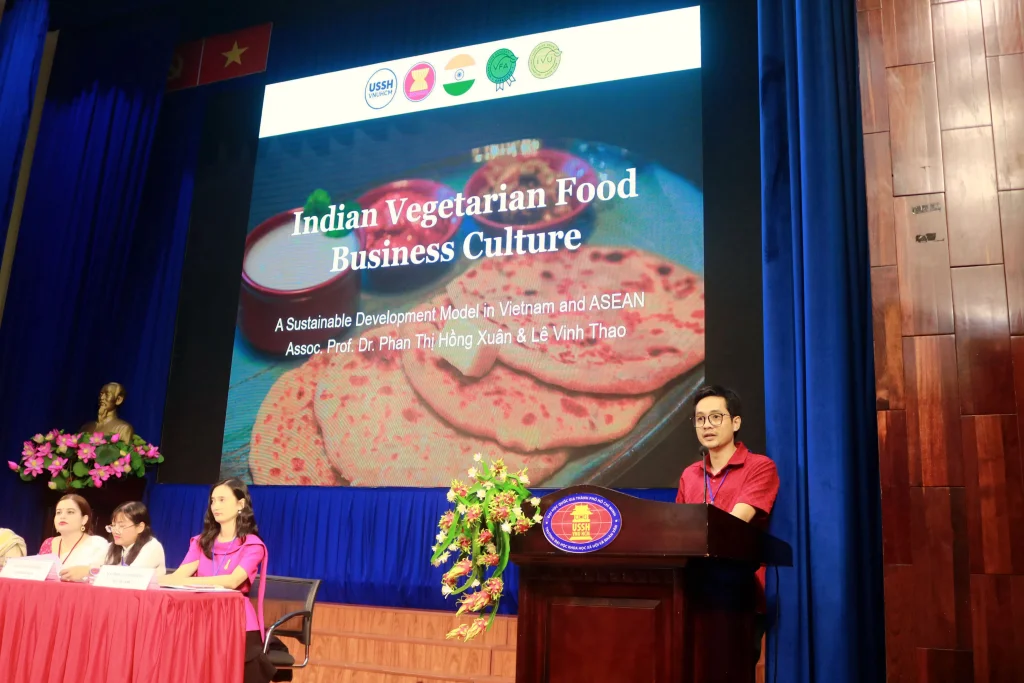
At the University of Social Sciences and Humanities (USSH), Viet Nam National University Ho Chi Minh City, an extraordinary convergence of philosophy, culture, and sustainable development took place on October 3. The International Conference “Indian and Vietnamese Business Culture: Identity and Values” marked not only the 156th birth anniversary of Mahatma Gandhi but also the 25th anniversary of the Department of Indian Studies — a dual celebration of moral legacy and intellectual growth.
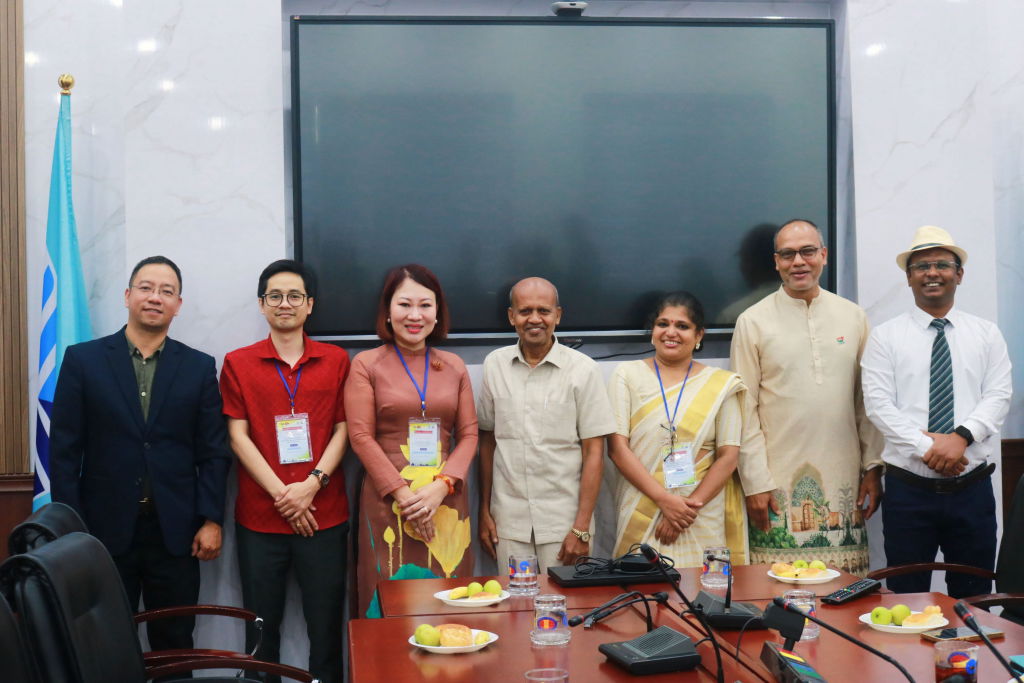
The event gathered an impressive array of diplomats, scholars, and cultural leaders from across Asia. In his opening remarks, Dr. Vipra Pandey, Consul General of India in Ho Chi Minh City (Indian Ministry of External Affairs), highlighted the enduring depth of India–Vietnam relations. He emphasized that the friendship between the two nations rests upon shared civilizational values of peace, respect, and moral responsibility — ideals that were central to Mahatma Gandhi’s vision of global harmony. Dr. Pandey praised the University’s ongoing commitment to fostering mutual understanding through academic and cultural exchange, noting that “this collaboration between Indian and Vietnamese scholars continues to serve as a living example of how education can strengthen the bonds of empathy and cooperation in an interconnected world.”
Among the voices that resonated powerfully during the event was that of Mr. Thao Le, IVU Counselor and VFA Regional Organizer for Vietnam, representing the International Vegetarian Union (IVU) in Asia. His presentation celebrated Gandhi’s message of non-violence and compassion through the prism of vegetarianism — bridging historical ideals and modern sustainable business culture in Asia.
Gandhi’s Enduring Message: Vegetarianism as Moral and Cultural Strength
Mr. Thao Le’s address offered a poignant reminder of how Mahatma Gandhi’s 1931 speech before the London Vegetarian Society (LVS) remains as vital today as it was nearly a century ago. Entitled “The Moral Basis of Vegetarianism,” the talk was delivered on November 20, 1931, during Gandhi’s stay in London for the Round Table Conference. In that gathering — attended by prominent British humanitarians such as Henry and Catherine Salt — Gandhi described vegetarianism not as a dietary restriction but as a moral discipline, an expression of non-violence that unites ethics, ecology, and human compassion.
Speaking before a hall filled with diplomats, academics, and students, Mr. Thao Le drew a direct line between Gandhi’s spiritual vegetarianism and modern business ethics in Asia. “For Gandhi, food was the first form of moral education,” he noted. “What we choose to eat reflects what we value — life, equality, and the planet we share.” Gandhi with the LVS in 1931, seated to his right (left as we look) are Henry and Catherine SaltHe recalled how Gandhi’s message at the London Vegetarian Society sought to connect Eastern and Western moral traditions — building bridges of understanding through the simple yet profound act of eating with conscience. At a time when global tensions were rising, Gandhi’s words — “We should seek to live simply so that others may simply live” — planted seeds that continue to bear fruit through today’s plant-based movements and ethical consumption trends across Asia.
While the 1931 event was organized by the London Vegetarian Society, Gandhi’s influence later inspired generations of vegetarian advocates worldwide, including the International Vegetarian Union (IVU), founded in 1908. As Thao Le emphasized, “IVU continues to carry Gandhi’s torch — transforming his message into global action through education, sustainable enterprise, and intercultural dialogue.”
A Dialogue Across Continents: Thao Le’s Conversation with IVU’s Marly Winckler
Adding depth to his presentation, Mr. Thao Le shared insights from a recent interview he conducted with Marly Winckler, the former Chair of the International Vegetarian Union and a long-standing advocate of ethical living.
In their exchange, Winckler reflected on India’s enduring role in shaping global vegetarian philosophy. “India has given the world not only the food but the meaning behind it,” she remarked. “The principle of ahimsa — non-violence — continues to guide the vegetarian and vegan movements toward sustainability and compassion.”
Thao Le linked Winckler’s reflections to the broader mission of the Vietnam Vegetarian Association (VFA) and IVU Asia. “Our collaboration with IVU demonstrates that vegetarianism is not just a lifestyle; it is a bridge of diplomacy — cultural, ecological, and humanistic,” he said. “Through shared values, Vietnam and India are crafting a future rooted in ethics and sustainability.”
Bridging Cultures Through Cuisine: The Indian Vegetarian Model in Vietnam and ASEAN
At the same conference, Assoc. Prof. Dr. Phan Thị Hồng Xuân and Mr. Thao Le co-presented a research paper titled “Idian Vegetarian Food Business Culture: A Model for Sustainable Development in Vietnam and ASEAN.(258 KB) ” The paper, rooted in extensive fieldwork across Ho Chi Minh City, Kuala Lumpur, and Singapore, explored how Indian vegetarian restaurants embody both business innovation and cultural diplomacy.
Their findings revealed that Indian vegetarian enterprises — from humble eateries in Saigon to world-renowned chains in Singapore — serve as “ethical microcosms” of India’s cultural philosophy. They are spaces where food, faith, and ethics intersect to promote sustainability and compassion.
In his remarks, Thao Le emphasized that these businesses are more than economic models; they are living embodiments of Gandhian thought. “Each vegetarian restaurant in our region — each plate of satvik food — tells a story of peace and shared humanity,” he said.
According to their research, Indian vegetarian businesses in ASEAN cities reflect the “Triple Bottom Line” principle — balancing profit, people, and planet. By sourcing organic ingredients, reducing waste, and fostering fair trade partnerships, they embody Gandhi’s vision of economic activity as a form of moral action.
From Gandhi’s London to Ho Chi Minh City: The Continuity of Compassion
The October 3 conference also symbolized a larger continuity — a philosophical journey from Gandhi’s 1931 London address to 21st-century Ho Chi Minh City. The themes of simplicity, non-violence, and ecological responsibility echoed throughout the plenary sessions, tying together the wisdom of India’s spiritual traditions with Vietnam’s modern aspirations for green growth and ethical business.
Assoc. Prof. Dr. Lưu Văn Quyết, Vice Rector of USSH, praised the event as “a testament to the deep friendship and mutual learning between India and Vietnam,” noting that the partnership continues to flourish amid globalization and digital transformation.
In this atmosphere of intellectual exchange, Thao Le’s presentation stood out for its blend of moral reflection and practical vision. He urged participants to view vegetarianism not only as a dietary or cultural expression but as a strategic foundation for sustainable development. “The Indian vegetarian business culture is a humanistic economic model,” he explained. “It integrates compassion into commerce, turning every meal into an act of respect — for life, for nature, for each other.”
The Future of Ethical Business and Cultural Diplomacy
The success of the Indian vegetarian model, as discussed at the conference, has broader implications for Vietnam and ASEAN. Cities such as Ho Chi Minh City, with their growing interest in sustainable living and conscious consumption, are fertile ground for ethical food enterprises.
Mr. Thao Le’s work, alongside the Vietnam Vegetarian Association and IVU Asia, aims to foster collaborations between entrepreneurs, educators, and cultural leaders to promote plant-based initiatives that support both ecological balance and intercultural understanding.
“Vegetarianism,” he noted, “is not a trend but a philosophy of coexistence. As we look to the future, it offers a path where cultural identity and global sustainability meet.”
His optimism resonated with the audience — many of whom were young scholars and entrepreneurs seeking to redefine business in ethical terms. As the applause filled the Van Khoa Hall, it became clear that the seeds sown by Gandhi nearly a century ago continue to grow — in new soil, among new generations, yet nourished by the same timeless values.
A Legacy Renewed
The International Conference on Indian and Vietnamese Business Culture reaffirmed the power of ideas that endure — ideas that cross borders and generations. In celebrating Gandhi’s birth anniversary and the 25th anniversary of Indian Studies at USSH, the event honored not only history but also the living spirit of cooperation.
For Mr. Thao Le, that spirit is best expressed through action — through the meal shared, the dialogue begun, and the ethical choice made each day. As he concluded:
“When we eat with compassion, we are not only feeding ourselves — we are nourishing peace.”
From Gandhi’s London lecture hall to today’s Ho Chi Minh City campus, that message continues to inspire. And thanks to leaders like Thao Le, the dialogue between India and Vietnam — between tradition and innovation — remains vibrantly alive, serving as both moral compass and cultural bridge in a rapidly changing world.